Mario Kart World feels like it really could last the full Switch 2 lifecycle
My Thoughts on Video Games – No Easy Winners
For me, no video game is an instant success just because of its name or hype. I never feel comfortable calling something a “sure thing” until I’ve actually spent a lot of time playing it. Take Grand Theft Auto 6—will it make a ridiculous amount of money? Of course. But do I have any reason to believe it’ll be Game of the Year in 2026 before even trying it? No way. Not even a demo is enough to convince me. That’s exactly how I felt when I played Mario Kart World back in April. Sure, it was fun—it’s Mario Kart, after all—but I still had big questions about its shift to an open-world, the wider tracks, and how the 24-player modes would hold up. I knew I needed way more hands-on time before making up my mind.
Now, with the Nintendo Switch 2 just days away from its June 5 release, I’ve finally had the chance to dive much deeper into the system’s biggest launch game. I’ve spent several hours with Mario Kart World, trying out everything from Free-Roam exploration to chaotic multiplayer modes like Coin Runners. And after all that time, I can confidently say this: Mario Kart World is going to be a must-have game for Switch 2 owners. There are still a few things I’m not completely sold on, but the mix of fast-paced multiplayer and relaxed solo exploration makes this a fantastic launch title—one that could easily keep players busy for hundreds of hours.
Exploring the Open World – Free-Roam Mode
My demo was split into different parts. The second half was all about multiplayer, where I raced against other journalists in every mode. But the first half was what really interested me—I got to play single-player however I wanted. I used that time to win two Grand Prix cups, race against my own ghost in Time Trial, and—most importantly—explore the open-world.
This last part was a big deal for me because, after my April demo, I wasn’t sure if Free-Roam had enough to keep players engaged. At first, my worries seemed justified. The mode lets you drive anywhere—on tracks, off-road, just cruising around. The world is gorgeous, with detailed environments, but early on, it felt a little empty. That said, it did show off the Switch 2’s power. At one point, I rode a rail up a mountain, then drove off the peak. The view was incredible—I could see for miles, with every tiny detail sharp and clear. It’s a huge step up from Pokémon Legends: Arceus, where distant textures would often look blurry. Still, besides running over a few enemies or getting randomly sucked up by a UFO, there wasn’t much to do at first.
But then I started figuring out how exploration works. There are three main things to find in Free-Roam:
- Peach Coins – These shiny tokens are hidden in tricky spots. I’m not entirely sure what they do yet, but they’re fun to collect.
- Question Mark Panels – Scattered around the world, these seem to unlock something when you find them all in a certain area. My progress was tracked on the map, so there’s definitely a reward waiting.
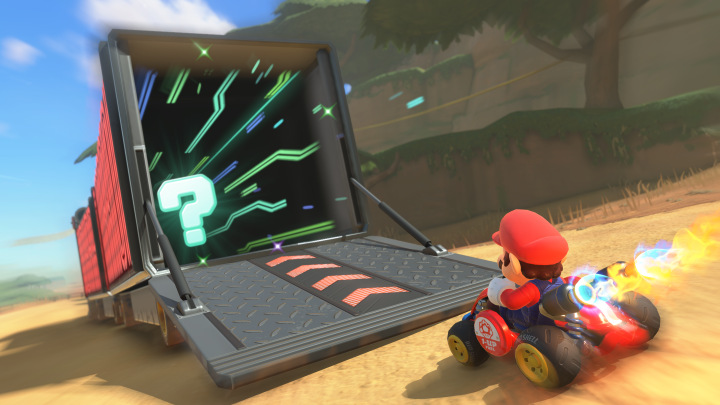
- P-Switches – These little blue switches are the real highlight. Hitting one starts a short challenge—like racing behind a truck to jump into its bed, grinding up vines into the sky, or collecting coins before time runs out. Most take less than a minute, and there are hundreds hidden all over the map. Some are out in the open, others tucked away in sneaky corners. At first, they seem rare, but that’s only because the map is so packed with little details. It’s not a huge world—I drove from one end to the other in about nine minutes—but it’s full of twists, turns, and vertical layers that make exploration exciting. Finding every P-Switch feels like a long-term goal, kind of like hunting down all the Koroks in Breath of the Wild.
By the end of my demo, Free-Roam had grown on me. Whenever I had downtime between multiplayer sessions, I’d jump back in to explore a little more. Doing this earned me stickers (which act like in-game achievements) and coins (used to unlock new karts—the first at 100 coins, then another at 300, and so on). You can also unlock characters and outfits by racing in Grand Prix or finding hidden items in the world.
Now, I finally get the appeal of Free-Roam. It’s not the main focus of the game—it’s more like a side activity for when you’re waiting for friends to hop online or just want to relax without racing. It feels like a mode designed to last the entire Switch 2’s lifespan, not something you’ll finish quickly.
Multiplayer Madness – Fast, Chaotic, and Fun
If Free-Roam is the chill side of Mario Kart World, then multiplayer is where things get crazy. Knockout Tour was the standout—a 24-player elimination mode where the goal is simply to survive. One wrong move, and you’re out. It had me yelling at the screen, cheering when I won and groaning when I got wrecked. When I was in the zone—drifting perfectly, using mushrooms at the right moment—it felt like a deep, skill-based racer.
One new mechanic, power jumping, adds a fresh layer of strategy. If you hold the drift button without touching the stick, you charge a jump. Land it, and you get a speed boost. Skilled players will probably use this non-stop to shave seconds off their times. But it’s tricky—even a slight nudge of the stick makes you drift instead. I messed it up a lot and ended up avoiding it, but I’m sure I’ll get better with practice.
Winning with advanced tricks feels amazing, but losing can be brutal. The game leans toward Mario Kart Wii’s style—items can completely flip a race in seconds, especially with 24 players. One moment, I’m in first; the next, I’m hit by a blue shell, lightning bolt, and Bullet Bill back-to-back. It’s chaotic, sometimes hilarious, sometimes frustrating—but that’s Mario Kart for you.
This actually made me appreciate the wider tracks more. I was worried they’d make races boring, but now I see why they’re needed—with so many players and so many items flying around, the extra space lets you dodge attacks by swerving. It adds a fun risk-reward element: Do I take the tightest line for speed, or do I stay wide to avoid getting hit? The power jump helps too—you can use it to strafe away from incoming shells. My best moment? Saving a feather from an item box and using it to hop over a golden shell at the last second. It’s little things like this that make the racing feel deeper than ever.
I also tried Battle Mode and Coin Runners (a 3-minute scramble to grab the most coins). Both use smaller maps (eight total) and test your driving skills in different ways. After a few losses, I started figuring out tricks—like hitting players head-on with a boomerang or saving hammers to take out multiple karts at once. These modes aren’t as stressful as Knockout Tour, but they still get intense when you’re up against skilled players.
Final Thoughts (For Now)
Even after all this time, I’m not ready to give a final verdict—that’ll come in my full review after the Switch 2 launches. Some tracks feel a little disjointed due to the open-world design, and I still need more time in Free-Roam to see if it stays fun in the long run.
But one thing’s clear: Mario Kart World is a blast, whether you’re playing casually or going full tryhard. As the Switch 2’s big launch title, it has a lot to live up to—but I don’t think it’ll disappoint. On June 5, it’ll be the first game I play, even after all the hours I’ve already put in. After all, this is just the beginning of my Mario Kart World journey.

Related Posts

Vibe Coding is Shoot and Forget Coding
Our favorite video games of 2025 so far: Clair Obscur, Blue Prince, and more